

Investing in Quanfluence: Building India’s First Photonic Quantum Computer
How a team of semiconductor founders in Bengaluru is attempting to build a room-temperature, fibre-connected quantum computer
Aman Raj and Venkatesh Peddi
Quantum computing spent forty years as a physics problem. It is now, mostly, an engineering problem. The open questions are no longer whether superposition and entanglement can be harnessed for computation; that has been settled in laboratories and peer-reviewed journals. The open questions are about optical loss budgets, fabrication yields, cooling costs, and whether any of the proposed architectures can actually be manufactured at scale.
That made us look seriously at Quanfluence.
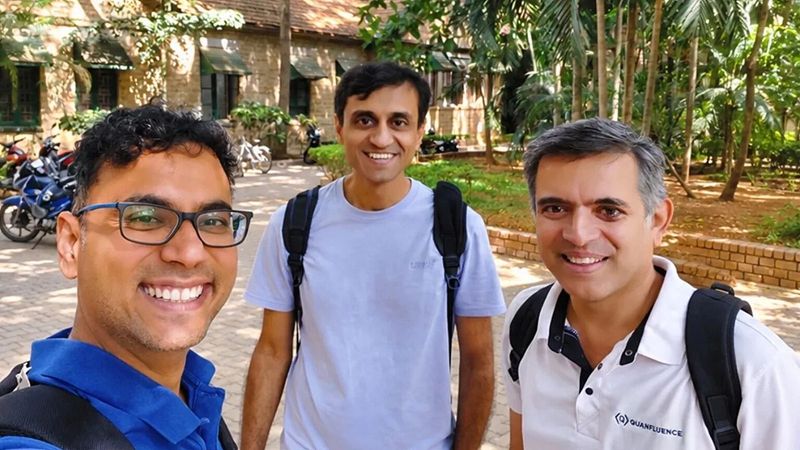
L-R – Biman Chattopadhyay, Ravi Mehta and Sujoy Chakravarty
The Scaling Wall
Almost every quantum computer you have read about is built on one of two approaches, and both are running into physical limits that are structural.
Superconducting qubits are the most widely deployed approach today. They are tiny circuits of superconducting material that behave like artificial atoms, and they only behave quantum-mechanically at around 15mK, colder than outer space. That requires dilution refrigerators costing millions of dollars each. Every qubit needs its own wiring running from room temperature down into the cryostat. Crosstalk between neighbouring qubits rises as you pack them closer. A dilution refrigerator has a hard ceiling on how many qubits it can host, and stitching several cryostats together is itself an unsolved engineering problem. After decades of work and billions of dollars, no superconducting platform has published a credible path to the millions of physical qubits that fault-tolerant computing will require.
Trapped ions produce the highest-quality qubits in the industry. Ions are natural quantum systems rather than engineered ones, so they hold their state longer and gate operations are more accurate. The bottleneck is control: each ion is manipulated by precisely aimed laser beams, and the control apparatus grows in complexity faster than the qubit count. Vibration or stray electromagnetic fields destroy the information. Today’s machines operate at tens to low hundreds of qubits.
Both approaches work. However, neither has yet shown how it reaches the scale that commercially useful quantum computing demands.
Why Light
Photons are the third option, and their properties look increasingly attractive as the field moves from demonstrations to manufacturing.
- Most of a photonic machine runs at room temperature. In Quanfluence’s design only one subsystem needs cooling, and it uses a 4K cryostat rather than a dilution refrigerator.
- Photons travel through optical fibre, the same infrastructure that carries the internet. Processing modules can be networked over standard fibre rather than crammed into a single refrigerator.
- Photonic circuits are fabricated in existing silicon photonics foundries using standard semiconductor processes. Quanfluence’s chips are already being made at a commercial silicon nitride foundry. No exotic custom fab is required.
- Photons interact weakly with their surroundings and that keeps them coherent and reduces error-correction overhead.
What They Have Built
Quanfluence is five years old and has a working lab in Bengaluru. Multiple photonic integrated circuits have been designed, fabricated and tested in-house: squeezers, wavelength multiplexers, interferometers, balanced homodyne detectors. Some of these products are already commercialised.The Architecture
Quanfluence is building a universal photonic quantum computer on a continuous-variable architecture with GKP-encoded qubits. In practice it is a five-stage pipeline. Telecom-grade pulsed lasers pump light into photonic chips, where micro-ring resonators squeeze it. The squeezed light then enters the Resource State Generator, where it interacts with quantum dots inside a nanophotonic cavity to produce cat states, which are bred into GKP qubits. Those qubits leave over optical fibre, are entangled through an interferometer network with fibre delay lines to form a large cluster state, and are finally measured one at a time by homodyne detectors. The act of measurement is the computation.
The Team
Sujoy Chakravarty, Biman Chattopadhyay and Ravi Mehta spent a combined three decades at Texas Instruments before founding Silabtech in 2012, a Bengaluru semiconductor company building high-speed SerDes and mixed-signal IP. They scaled it and sold it to Synopsys in 2018, stayed through the integration, and left in 2021 to start Quanfluence. They are joined by two academic co-founders: Prof. Anil Prabhakar of IIT Madras, Project Director of the National Quantum Mission hub on quantum communications, and Prof. Sandeep Goyal of IISER Mohali.Our Conviction
We are leading Quanfluence’s $10M Series A. It is a bet on two propositions: that when useful quantum computers are built, they are more likely to be built on light than on anything else, and that a country which intends to secure its own banking, defence and research infrastructure should own that capability rather than rent it. Sujoy, Biman, Ravi and the team have spent five years quietly assembling the physics, the patents and the manufacturing relationships to make that possible from Bengaluru. We are glad to be backing them.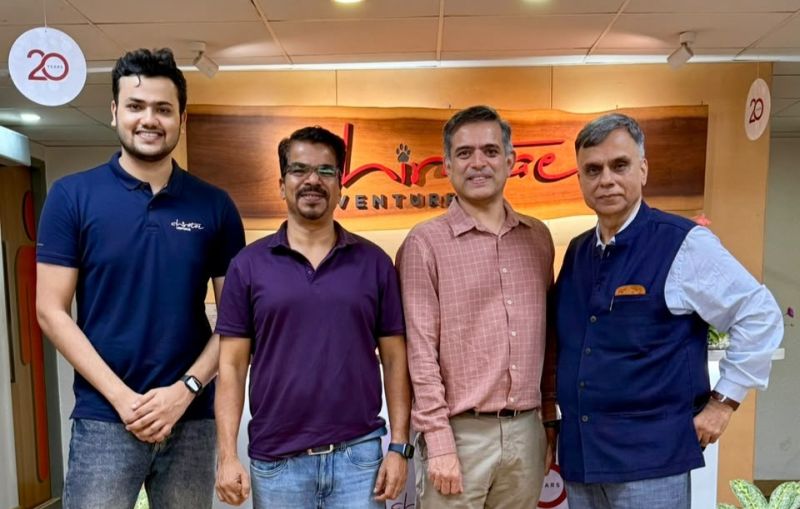
L- R – Aman Raj, Venkatesh Peddi, Sujoy Chakravorty and Sudhir Sethi